


2027 Rate Changes - Alabama: +20.7% indy mkt (FINAL); +12.5% sm. group (preliminary)
Tue, 09/08/2026 - 5:27pm
Originally posted 8/06/26
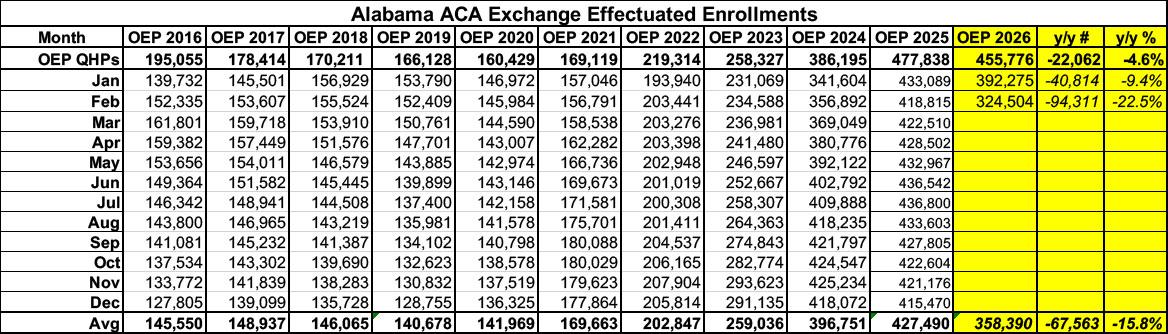
ACA exchange enrollment has dropped by nearly 23% in Alabama since Congressional Republicans allowed the enhanced federal subsidies to expire at the end of last year.
Initial signups during Open Enrollment were already down 4.6% vs. OEP 2025...but effectuated enrollment as of January 2026 was down over 9% year over year...increasing to a 22.5% drop as of February.
That's over 94,000 Alabamans who already lost coverage in just the first two months of the year...a number which has likely continued to climb since then.
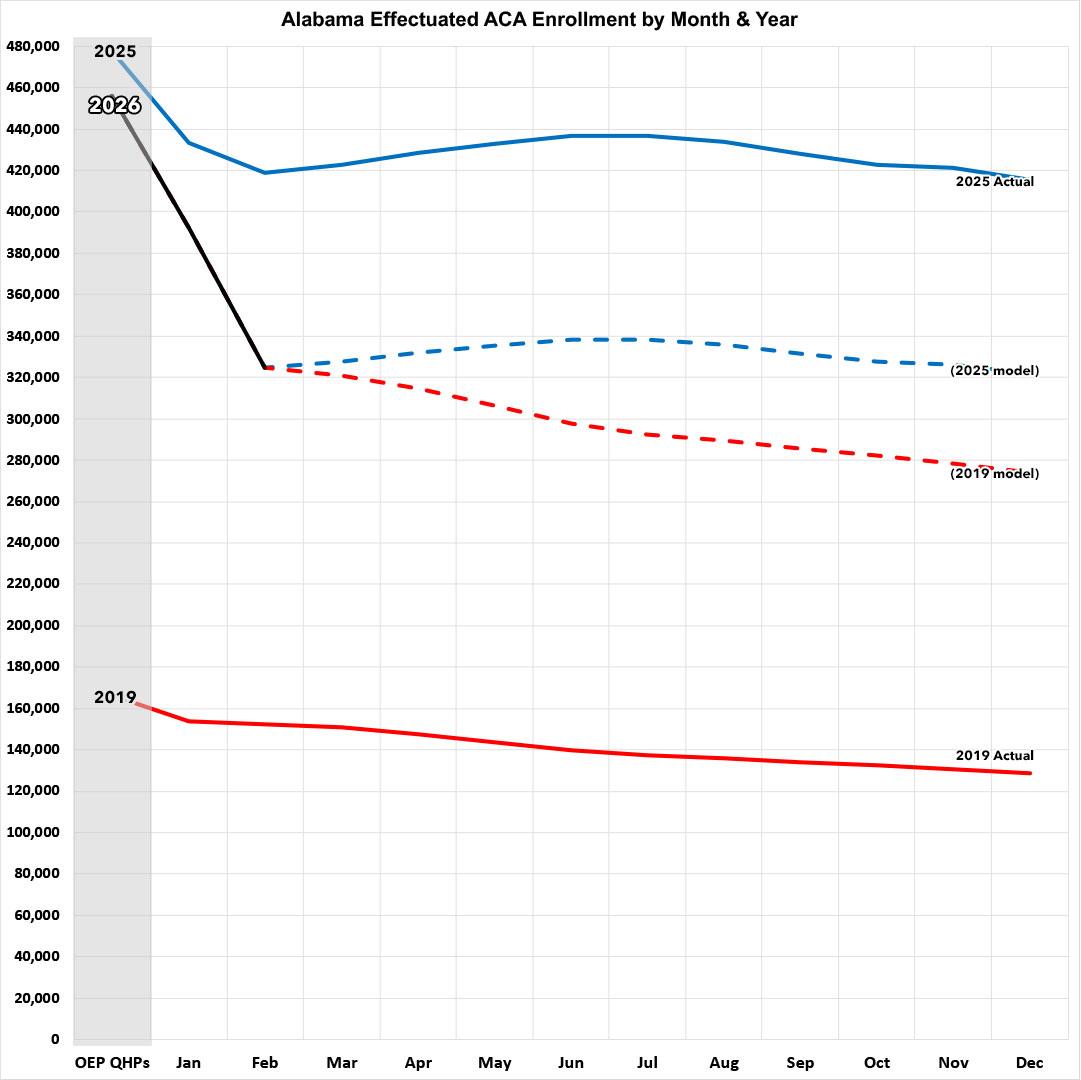
Here's what this looks like visually, with both 2025 and 2019 (the last pre-COVID year, which didn't include the enhanced subsidies) included for comparison:
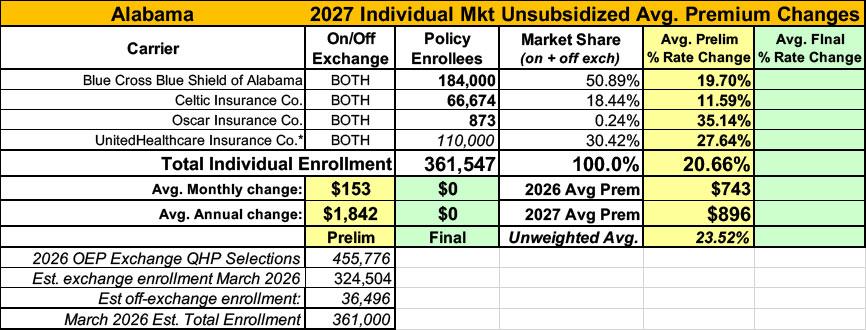
Looking ahead to 2027, the preliminary rate filings for both the individual and small group markets are now available via the federal Rate Review database:
BLUE CROSS BLUE SHIELD OF AL
Scope and Range of the Rate Increase
The average rate increase included in this filing is 19.7%, affecting almost 184,000 members. The main factors driving the need for this increase are:
- Alabama market membership loss and remaining members projected to be less healthy during the second year following the end of the enhanced premium subsidies in 2026, which were in place since 2021.
- Projected 2026 claim cost trends are higher than projected in the 2026 filing. Higher claim cost trends are projected to continue into 2027.
The premium change experienced by each policyholder will likely differ from the rate increase listed above for the chosen plan because individual and family plan premiums vary based on the age(s) of the individual(s) on the plan, the policyholder’s geographic area, and the number of family members included on the plan as permitted under the ACA.
Enhanced Advance Premium Tax Credits Allowed to Expire for plan year 2026 and later.
Enhanced Advance Premium Tax Credits (enhanced premium subsidies) that were made available in 2021 and 2022 through the American Rescue Plan Act (ARPA) and extended after 2022 by the Inflation Reduction Act (IRA) were allowed to expire by the Federal government and are not available after 2025. As a result of these enhanced premium subsidies, the total Alabama Individual ACA Market grew from 195,000 in 2021 to over 475,000 in 2025. Market membership has dropped below 360,000 YTD in 2026 and is expected to drop further throughout the rest of 2026 and 2027.
Assumptions in this rate filing related to this change:
- BCBSAL is projecting that a substantial number of Individual members will leave the Alabama Individual ACA market in 2027, similar to 2026, as enhanced premium subsidies remain unavailable and members are no longer able to afford their out-of-pocket premiums.
- Members leaving the market are projected to be healthier than average, which will leave the total Alabama market (or single rating pool) projected to be less healthy in 2027.
Changes in Medical Service Costs
BCBSAL expects per capita claim costs to increase around 5% from 2026 to 2027, mainly due to increasing costs for hospital services and prescription drugs. Hospital costs are expected to grow due to increases in both reimbursement levels and the number of services performed. Prescription drug costs continue to escalate largely due to GLP-1s, new expensive drugs and new covered indications for existing drugs.
Changes in benefits
Overall, changes to benefits in 2027 were minor and generally made to satisfy the Actuarial Value ranges required by law. For 2027, these changes helped to reduce the requested rate change by 3-4%.
Financial Experience of the Product
BCBSAL measures the financial performance of its products using the traditional Medical Loss Ratio (“MLR”) calculation. The MLR is equal to claim costs divided by premium revenue. The target MLR for the Individual market in 2025 was approximately 92%, and actual MLR has emerged at nearly 93%. This means that 8% of premium was needed for non-benefit expenses such as administrative costs, taxes and fees, and contribution to surplus, but only 7% was available after paying benefit expenses.
BCBSAL expects the MLR in 2026 to be nearly 98% mostly due to claims being higher than projected when developing premiums for 2026 where the projected pricing Loss Ratio was approximately 88%.
Based on the rate increases listed above, BCBSAL expects the average MLR for the Individual market to be near the target MLR of about 86% in 2027.
Administrative Cost and Anticipated Margins
Administrative expenses for 2026 have come in as predicted but are expected to increase in 2027 due to overhead expenses being spread over fewer members. Also, this market is perceived to remain volatile, and therefore we have increased our Contribution to Surplus and Risk closer to our historical target for this market of 5%. Finally, 2027 taxes and fees are decreasing nearly 0.7% per CMS’ 2027 Notice of Benefit and Payment Parameters guidance to carriers helping to partially offset the overall increase to rates for 2027.
CELTIC INSURANCE CO
Celtic Insurance Company is filing rates for the individual block of business, effective January 1, 2027. This document is submitted in conjunction with the Part I Unified Rate Review Template and the Part III Actuarial Memorandum.
This information is intended for use by the Alabama Department of Insurance, the Center for Consumer Information and Insurance Oversight (CCIIO), and health insurance consumers in Alabama to assist in the review of Celtic Insurance Company’s individual rate filing.
The results are actuarial projections. Actual experience will differ for a number of reasons, including population changes, claims experience, and random deviations from assumptions.
In 2025, earned premium was $627.12 per member per month (PMPM). Incurred claims in 2025 were $410.94, or 65.53% of premium. Netting risk adjustment from the claims results in an estimated loss ratio (incurred claims net of estimated risk adjustment transfers, divided by earned premiums) of 69.50%. We expect unit costs to increase for 2027. Further, we have updated underlying experience for the single risk pool, expected administrative expense, and assumptions for federal risk adjustment. These factors, as well as changes to the assumed morbidity of the single risk pool and medical trend, result in a premium rate increase.
Medical trend, or the increase in health care costs over time, is composed of two components: the increase in the unit cost of services and the increase in the utilization of those services. Unit cost increases occur as care providers and their suppliers raise their prices. Utilization increases can occur as people seek more services than before. Additionally, simple services can be replaced with more complex services over time, which is known as service intensity trend. An example of service intensity trend would be the replacement of an X-ray with an MRI scan. Replacing the service with a more intense service causes the total cost of medical services to increase.
The proposed rate change of 11.6% applies to approximately 66,674 individuals. Celtic Insurance Company’s projected administrative expenses for 2027 are $99.25 PMPM. Administrative expense does not include $35.72 for taxes and fees. The historical administrative expenses for 2026 were $83.64 PMPM, which excludes taxes and fees. The projected loss ratio is 83.2% which satisfies the federal minimum loss ratio requirement of 80.0%.
OSCAR INSURANCE CO
1. Scope and Range of Rate Increase
The purpose of this document is to present rate change justification for Oscar Insurance Company (Oscar’s) Individual Affordable Care Act (ACA) products, with an effective date of January 1, 2027, and to comply with the requirements of Section 2794 of the Public Health Service Act as added by Section 1003 of the Patient Protection and Affordable Care Act (ACA).
Using in-force business as of May 2026, the proposed average rate increase for renewing plans is 35.1%. Rate increases vary by plan due to a combination of factors including shifts in benefit leveraging and cost-sharing modifications and network changes. This rate increase is absent of rate changes due to attained age.
The rate increase impacts an estimated 873 members.
2. Reason for Rate Increase(s)
The significant factors driving the proposed rate change include the following:
- Medical and Prescription Drug Inflation and Utilization Trends
The projected premium rates reflect the most recent emerging experience which was trended for anticipated changes due to medical and prescription drug inflation and utilization.
- Administrative Expenses, Taxes and Fees, and Risk Margin
Changes to the overall premium level are needed because of required changes in federal and state taxes and fees. In addition, there are anticipated changes in both administrative expenses and targeted risk margin.
- Prospective Benefit Changes
Plan benefits have been revised as a result of changes in the Center for Medicare and Medicaid Services (CMS) Actuarial Value Calculator and state requirements, as well as for strategic product considerations.
- Anticipated Changes in the Average Morbidity of the Covered Population
Changes to the overall premium level are needed because of anticipated changes in the underlying morbidity of the projected marketplace.
- Anticipated Changes in the Network Configuration
Changes to the overall premium level are needed because of anticipated changes in the underlying network configuration and associated unit costs.
UNITEDHEALTHCARE INSURANCE CO:
The following memorandum describes the key drivers of the rate changes of individual rates for UnitedHealthcare Insurance Company (“UHIC”). UHIC policies are individual medical plans offered in Alabama and are fully compliant with the Patient Protection and Affordable Care Act.
Scope and Range of the Rate Increase
UHIC is filing 2027 rates for individual products. The proposed rate change is 27.64% and will affect XXX individuals. The rate changes vary between 17.98% and 29.51%. Given that the rate changes are based on the same single risk pool, the rate changes vary by plan due to plan design changes.
Financial Experience of the Product
The premium collected in plan year 2025 was $931,325,284. Incurred claims during this period were $639,766,839 and UHIC expects payments of $105,963,937 for risk adjustment. The loss ratio, or portion of premium required to pay medical claims, for plan year 2025 is 77.51%.
Changes in Medical Service Costs
There are many different healthcare cost trends that contribute to increases in the overall U.S. healthcare spending each year. These trend factors affect health insurance premiums, which can mean a premium rate increase to cover costs. Some of the key healthcare cost trends that have affected this year’s rate actions include:
- Increasing cost of medical services: Annual increases in reimbursement rates to healthcare providers, such as hospitals, doctors, and pharmaceutical companies.
- Increased utilization: The number of office visits and other services continues to grow. In addition, total healthcare spending will vary by the intensity of care and use of different types of health services. The price of care can be affected using expensive procedures such as surgery versus simply monitoring or providing medications.
- Higher costs from deductible leveraging: Healthcare costs continue to rise every year. If deductibles and copayments remain the same, a higher percentage of healthcare costs need to be covered by health insurance premiums each year.
- Impact of new technology: Improvements to medical technology and clinical practice often result in the use of more expensive services, leading to increased healthcare spending and utilization.
- Reduction of premium subsidies: Expanded and enhanced federal premium tax credits for consumers expired at the end of 2025. As a result, there will be sicker members on average in the insurance pool as healthier members exit the market.
Changes in Benefits
Changes in benefits impact costs and therefore affect premium changes. Plan benefits are typically changed for one of three reasons: to comply with the requirements of the Affordable Care Act or state law, to respond to consumer feedback, or to address a particular medical cost issue to provide greater long-term affordability of the product.
The Affordable Care Act implemented requirements for the “value” that must be offered by plan designs in the Individual and Small Group markets. These are called “metal levels”. For a benefit plan to remain classified within a particular metal level from year to year, adjustments to deductibles, copayments or coinsurance are sometimes required. These adjustments impact the cost and therefore the premium increases for the plan.
Administrative Costs and Anticipated Margins
UHIC works to directly control administrative expenses by adopting better processes and technology and developing programs and innovations that make healthcare more affordable. We have led the marketplace by introducing key innovations that make healthcare services more accessible and affordable for customers, improve the quality and coordination of healthcare services, and help individuals and their physicians make more informed healthcare decisions.
Taxes and fees imposed by the state and federal government are significant factors that impact healthcare spending and must be included as additional administrative costs associated with the plans. These fees include Affordable Care Act taxes and fees which impact health insurance costs and need to be reflected in premium. Another component of premium is margin, which is set to address expected volatility and risk in the market.
The requested rate change is anticipated to be sufficient to cover the projected benefit and administrative costs for the 2027 plan year.
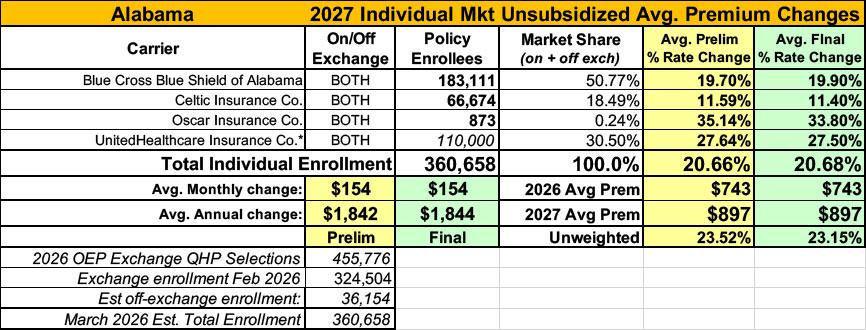
Combined, this amounts to a further 20.7% weighted average rate increase for unsubsidized enrollees, pushing the average per enrollee up to nearly $900 per MONTH.
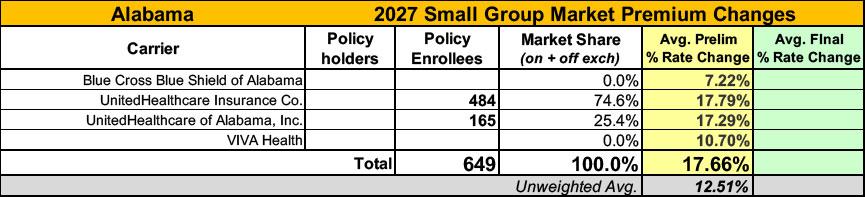
Meanwhile, Alabama's small group market enrollees are looking at non-weighted average rate increases of 12.5% (I only have the effectuated enrollment for two of the four carriers, and those are the smallest of the four anyway):
UPDATE 9/8/26: via the Alabama Dept. of Insurance:
The Alabama Department of Insurance (ALDOI) has approved the proposed 2027 premium rates for carriers with QHPs for the Affordable Care Act Individual Market in Alabama. The rates will be effective on January 1, 2027. The four QHP carriers in the Alabama individual market are Blue Cross Blue Shield of Alabama (BCBS), UnitedHealthcare Insurance Company (UHC), Celtic Insurance Company (CIC), and Oscar Insurance Company (Oscar). On average, rates for BCBS increased 19.9%, rates for UHC increased 27.5%, rates for CIC increased 11.4%, and rates for Oscar increased 33.8%. The actual rates and the supporting material may be found by clicking on the links below.
Consumers with an insurance question may contact the Alabama Department of Insurance, Consumer Services Division, using the contact information below. The Department also maintains a Live Chat feature for consumers at our website at www.aldoi.gov. A representative will be happy to help answer your questions.
For the most part these are nominal tweaks; overall they barely move the needle at all, leaving the weighted average at the same 20.7% market-wide:
The press release doesn't mention the final rulings regarding small group market carriers, however.
Advertisement


