


2027 Rate Changes - Pennsylvania: +17.1% indy mkt; +11% sm. group mkt
Mon, 07/27/2026 - 3:24pm
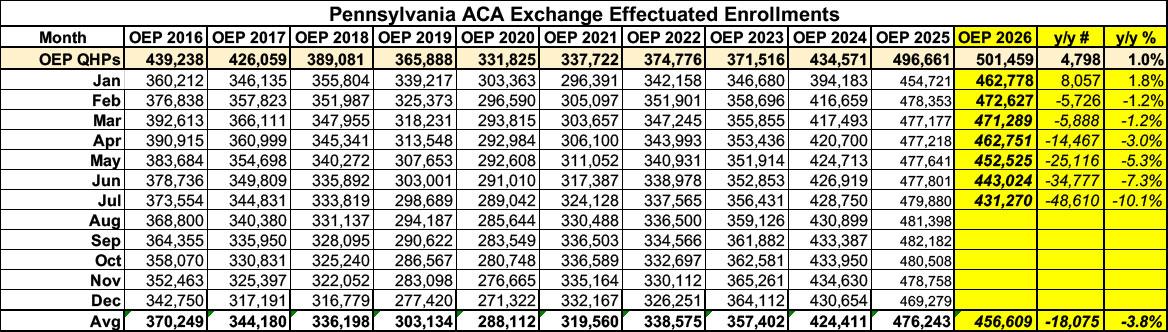
Before I begin, it's important to note that ACA exchange enrollment has dropped in Pennsylvania since Congressional Republicans allowed the enhanced federal subsidies to expire at the end of last year...although thanks to the state implementing fairly robust Premium Alignment pricing, it's not nearly as dramatic a drop-off as in most other states.
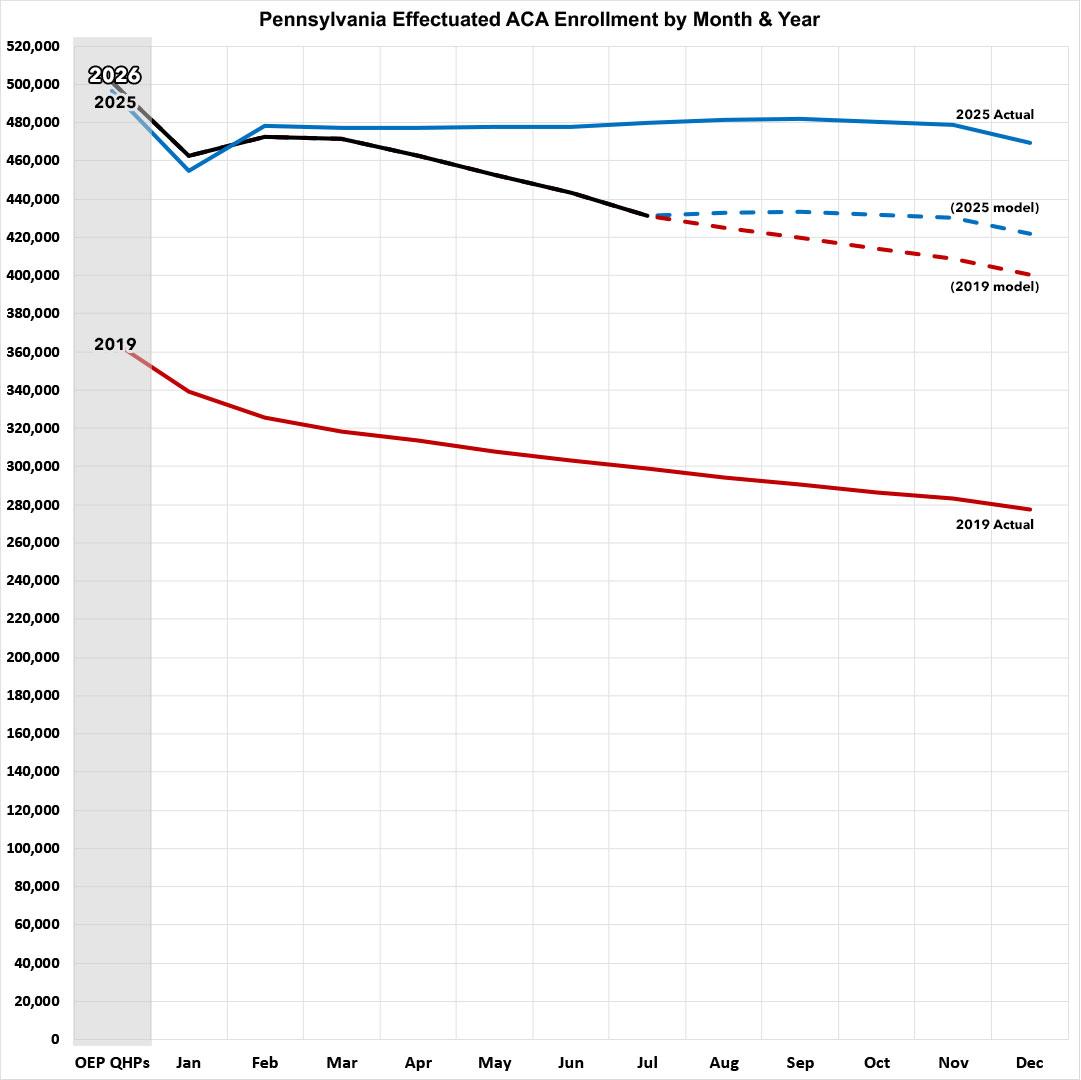
Initial signups during Open Enrollment were actually slightly higher than last year...but effectuated enrollment began to drop starting in February and has continued to drop at an increasing rate every month since then. As of July 2026, effectuated enrollment is down more than 10% vs. a year earlier, and it's down nearly 4% on average for the year so far. That's 48,000 fewer Pennsylvanians with ACA exchange coverage as of July:
Here's what this looks like visually, with both 2025 and 2019 (the last pre-COVID year, which didn't include the enhanced subsidies) included for comparison:
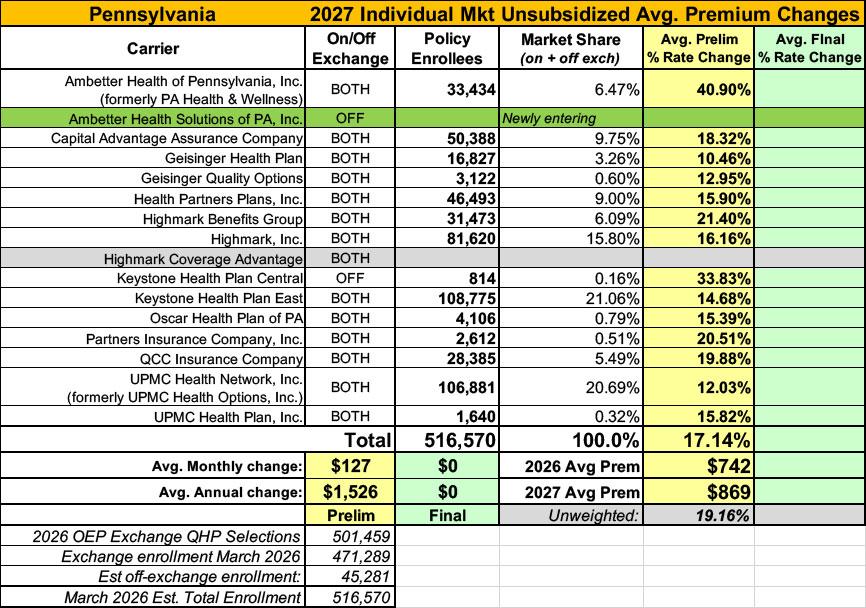
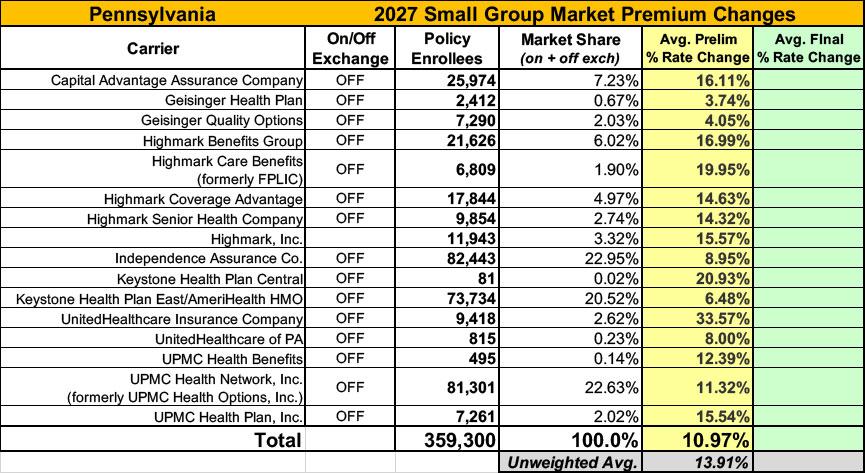
Looking ahead to 2027, the preliminary rate filings for both the individual and small group markets have been published by the Pennsylvania Insurance Department, and as with most states so far it's not looking pretty for those who earn more than 4x the Federal Poverty Level (FPL):
Ambetter Health of Pennsylvania:
The rate projections for 2027 have been updated from the previous year’s projections to reflect the most recent assumptions and information available.
The following describes and quantifies the significant drivers underlying the proposed rate change for 2027. This breakdown is intended only for explanatory purposes and is distinct from the development of rates, as described in the subsequent sections of this memorandum.
- Single Risk Pool Experience and Morbidity (19.2% premium impact versus 2026 filed rates) The individual single risk pool experience underlying the rate projections has been updated.
The current model reflects the projected utilization trend applied to adjusted experience (from 2025 to 2027), including anticipated changes in the average morbidity of the single risk pool. There is a full description of utilization trend and other projection factors applied to experience in Section 6, "Trend Factors".
Risk adjustment transfer experience for 2027 includes consideration of changes to the statewide average premium, the Risk Adjustment program, and Ambetter Health enrollee population morbidity relative to the Pennsylvania single risk pool.
- Unit Cost trend (8.6% premium impact versus 2026 filed rates)
Unit costs and provider reimbursement agreements have been updated to reflect changes in the rating year.
- Benefit Design and CSR Subsidies (-4.4% to 35.3% premium impact versus 2026 filed rates, varies by plan)
Ambetter Health’s 2027 rates assume no change in covered EHB or non-EHB benefits relative to benefits offered in 2026. The rates do reflect updated projections of actuarial value and cost sharing by plan. Premium rates continue to reflect the expectation that Ambetter Health will not be reimbursed by the U.S. Department of Health and Human Services (HHS) forcost-s haring on CSR Silver plans.
- Administrative Expenses and Profit (2.4% premium impact versus 2026 filed rates)
See Section 2b, "Retention Items", for details on projected non-benefit expenses.
- Other
These components include capitation contracts, changes in the 1332 program, and interactions between prior steps.
...Impact of eAPTC Expiration
To account for eAPTC expiration prior to the 2027 benefit year, we have assumed rates will increase due to anticipated reductions in enrollment, both at the issuer and single risk pool level. As eAPTCs expire and enrollees subsequently face increased out-of-pocket premiums, we assume healthier individuals who tend to be more price sensitive will leave the market, worsening the average morbidity of the individual risk pool.
If enhanced subsidies were extended, the key assumption changes to pricing year 2027 would be to:
- Experience Development, Morbidity, and Risk Adjustment
- Non-benefit expenses
Capital Advantage Assurance Company
CAAC is proposing an aggregate annual 18.3% rate change, which varies by plan. The rate change is calculated in PA Rate Exhibits Part IV, Table 11, cell AN13. The key drivers of the rate change and approximate impact are as follows:
- Future cost and utilization: 11.5%
- 2025 claims net risk adjustment: 5.8%
- 2026 rate increase: -6.5%
- Change to reinsurance parameters: 1.5%
- Enhanced subsidies end: 3%
- Continued fraud: 3%
The additional 3% bump due to the lingering impact of the GOP killing the enhanced subsidies isn't surprising to me, but the 3% to account for "continued fraud" is. Here's more details on that:
...The Other Morbidity Factor has two parts. The first part is due to the expiration of enhanced subsidies in 2025. This factor of 1.03 is carried forward from the 2026 filing as the impact of the subsidy expiration is not reflected in 2025 experience.
The second part of the Other Morbidity factor is due to ongoing fraudulent claims. CAAC requests that the proposed 2027 rates include a 3.0% adjustment to reflect the ongoing impact of fraudulent claims activity that has materially distorted CAAC’s claim experience to-date, and is expected to continue into the rating period. CAAC has observed fraud schemes involving false Pennsylvania residency information and misuse of heritage status to obtain or maintain Marketplace enrollment through Pennie, even though residency and heritage status are subject to eligibility and verification requirements.
In these cases, fraudsters target vulnerable individuals suffering from substance use disorder, enroll them in coverage, and then quickly transport them to out-of-state substance use disorder treatment facilities, where they are cycled through multiple levels of care for extended periods while providers submit large claims to issuers.
After identifying this activity, CAAC, along with other issuers, has worked extensively with Pennie to report the issue, strengthen controls, and limit further abuse; however, despite those efforts, the adverse claims impact has been significant and must be reflected in 2027 rates. The requested 3.0% increase is intended to be a conservative and member-friendly approach that seeks to minimize unnecessary premium disruption while also ensuring that rates remain financially responsible and actuarially sound, and CAAC respectfully reserves the option to initiate and revise this rate adjustment, as appropriate, before final rate approval based on emerging experience.
It's important to remember that, once again, the fraud being referred to here is on the part of unscrupulous third party actors, NOT the actual enrollees themselves.
Geisinger Health Plan
This filing applies to HMO and POS products, sold on and off exchange in rating areas 2, 3, 5, 6, 7 and 9. There will be 24 gold plans, 11 silver plans, 15 bronze plans, as well as 4 catastrophic plans, for a total of 54 plans offered in 2027. For every county in our service area, we will continue to have one silver plan offered Off-Exchange only. These plans do not include the adjustment of the defunding of CSR and therefore are lower priced than a similar plan offered On-Exchange. As of February 2026, 16,827 covered lives and 12,326 policyholders will be impacted by this filing. The proposed overall rate increase is 10.5% but is not uniform by plan. The increases range from 6.2% to 13.2%. Table 11 shows the increases at the plan level. These increases vary by plan due to benefit changes necessary to maintain the desired metal level as well as changes in pricing and induced demand factors.
Average Rate Change
The average rate change from Table 11, cell AN13 is 10.5% and is entered as the “percent rate change requested” in the SERFF Rate Review Detail Screen. It is the change in 21-year-old non-tobacco premium PMPM (as instructed by the Department).
...On 12/31/25, the Expanded Subsidies provided by ARPA expired. A significant reduction in enrollment was expected, but that did not happen. Geisinger experienced significant growth in enrollment. Our belief is that the turmoil of the subsidy change enticed more members to shop for plans than in standard years. As a result, approximately 3,000 more members are in GHP and GQO’s individual ACA plans in 2026 than in December of 2025. It is believed that these members are new to GHP or GQO and not new to the ACA market in general. A third-party vendor analyzed the enrollment in the PA ACA market and compared those who stayed vs those who departed. The analysis modeled several scenarios with the morbidity change estimated between 0.3% and 1.2%. GHP has selected 1.0% as our morbidity adjustment to reflect the change in membership by relying on this analysis. This adjustment is enteredinto Table 5 as 1.01.
...At this time, there is no proposed legislation or action that would restore the enhanced subsidies that ended 12/31/2025. If additional subsidies are introduced for the ACA market, the design of those subsidies would be analyzed and an impact to the market would be estimated. The following assumptions could change:
- Projected Membership
- Percent of On-Exchange Members
- Morbidity
- Other Adjustments
Keystone Health Plan Central (KHPC)
KHPC is proposing an aggregate annual 33.8% rate change, which varies by plan. The rate change is calculated in PA Rate Exhibits Part IV, Table 11, cell AN13. The key drivers of the rate change and approximate impact are as follows:
- Future cost and utilization: 11.8%
- 2025 claims net risk adjustment: 27%
- 2026 rate increase: -6.5%
- Change to reinsurance parameters: 1.5%
Keystone Health Plan East (KHPE)
The average proposed rate change shown in Cell AN13 of Table 11 is 14.7%. The changes to the single risk pool gross premium average rate per member per month (PMPM) from calendar year 2026 to calendar year 2027 are incorporated into the pricing and reflected in the Unified Rate Review Template.
...We project that rates would be approximately 2% lower should the enhanced Federal Rate Subsidies be restored due to improved market morbidity. This is based on advice from consulting actuaries.
UPMC Health Network, Inc.
The rate change for UPMC Health Network Individual plans is 12.03% for 2027. Rate change drivers include the following:
- Increases in medical and pharmacy cost and utilization
- Anticipated increase in plan liability as a result of the expiration of enhanced federal Premium Tax Credits
Scope and Range of the Rate Increase
The number of individuals affected by this rate increase is 106,881. The proposed rate increase varies by plan due to various changes made to meet AV requirements on a plan-by-plan basis. The range of the proposed rate change is -1.07% to 22.72%.
UPMC Health Plan, Inc
The rate change for UPMC Health Plan Individual plans is 15.82% for 2027. Rate change drivers include the following:
- Increases in medical and pharmacy cost and utilization
- Anticipated increase in plan liability as a result of the expiration of enhanced federal Premium Tax Credits
Scope and Range of the Rate Increase
The number of individuals affected by this rate increase is 1,640. The proposed rate increase varies by plan due to various changes made to meet AV requirements on a plan-by-plan basis. The range of the proposed rate change is 2.99% to 16.76%.
Advertisement


