


How much of a difference did state mitigation efforts make in enrollment? Quite a bit.
Fri, 03/06/2026 - 3:06pm
Over the past week or so, a few more state-based ACA exchanges have quietly published their final, official 2026 ACA Open Enrollment Period data, including Connecticut (157,246 plan selections), New Jersey (509,192), the District of Columbia (16,053) and Virginia (370,088). With these updates, practically all of the official 2026 OEP topline numbers are now filled in except for the following:
- Georgia: Missing 5 days of data (currently down 13.9% y/y)
- Illinois: Missing 21 days of data (currently down 5.2% y/y)
- Kentucky: Missing 5 days of data (currently down 11.4% y/y)
- New York: Missing 21 days of data (currently down 6.1% y/y)
- Rhode Island: Missing 21 days of data (currently down 9.6% y/y)
- Vermont: Missing 5 days of data (currently down 7.5% y/y)
Aside from this, total 2026 OEP plan selections stand at 23,063,235, which is down 5.2% (-1,256,478) from 2025 overall.
Ahead of and during OEP, I noted that multiple states (mostly blue ones but a handful of purple & red states as well) were taking action to at least partly (and in one case fully) mitigate the damage to enrollment & affordability being caused by the combination of:
- The expiration of the enhanced federal ACA tax credits as of the end of 2025;
- Administrative policy changes included in the Centers for Medicare & Medicaid Services' (CMS's) so-called "Integrity & Affordability Rule" released last spring; and
- Other ACA policy changes codified into law by last year's so-called "Big Beautiful Bill."
The measures being taken by these states fall into three main categories: Supplemental financial subsidies; premium alignment pricing policies; and special programs like Basic Health Plans (BHPs) or "Public Options" (which aren't really that).
It's important to keep in mind that some states already had one or more of these measures in place before 2026 and are simply continuing them or but have dramatically revamped/expanded on them, while others have newly-implemented these programs...often doing so specifically as an attempt to counteract the expiring federal subsidies.
Here's the breakdown:
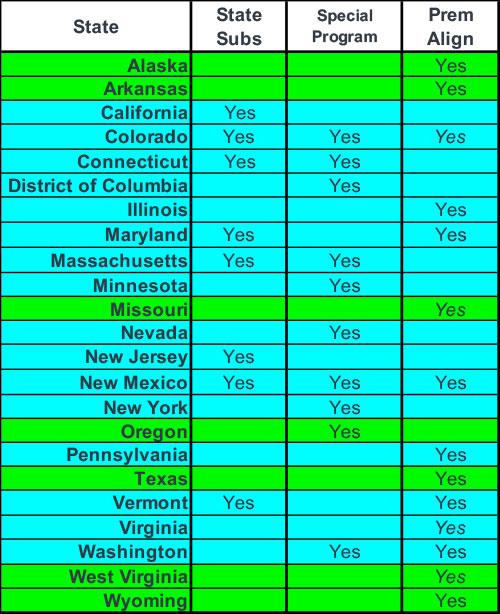
Even within these 23 states, there's a lot of variables:
- Some state subsidy programs are pretty generous: New Mexico, in fact, is fully backfilling 100% of all lost federal subsidies for all enrollees as well as keeping their existing supplemental subsidy program in place, while Vermont and New Jersey are keeping their more modest existing state subsidy programs in place without any changes. Other states are somewhere in between.
- The Special Programs range from Basic Health Plans in DC, MN, NY & OR (DC is new this year) to quasi-Public Options in CO, NV & WA (NV's is new this year).
- Some states have robust Premium Alignment policies (Alaska, Arkansas, Illinois & Vermont) while others are fairly weak (Colorado, Maryland, Missouri & Virginia).
Having said all of that, here's what total 2026 OEP enrollment looks like broken out by these criteria:
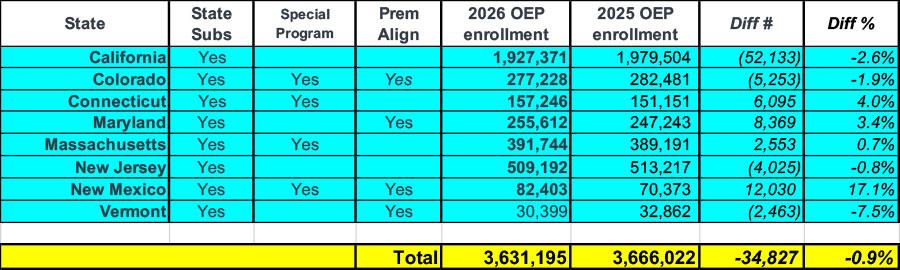
Across the 8 states which have dedicated state-based supplemental premium subsidy programs, total enrollment is only down 0.9% year over year.
While the variables are too complicated to do a straight extrapolation across all 50 states, if you did do so, that would mean a national enrollment drop of just ~218,000...suggesting that over a million more people would have enrolled.
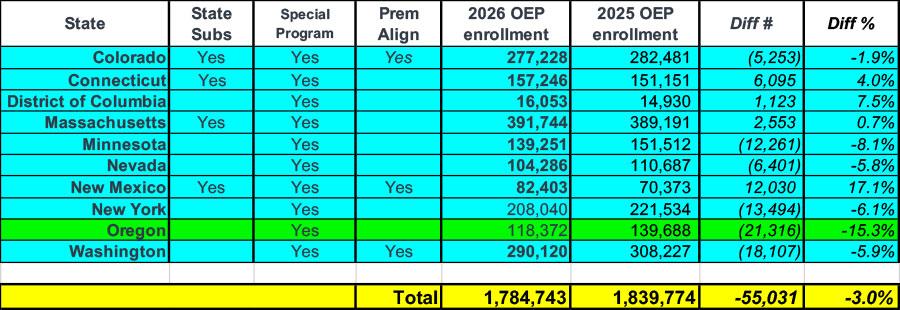
Across the ten states which have Basic Health Plans, "Public Options" or some other special healthcare program in place, enrollment is down 3.0% y/y.
Again, if you were to extrapolate that out nationally, it would amount to a net enrollment drop of ~640,000 people, or half of the actual drop.
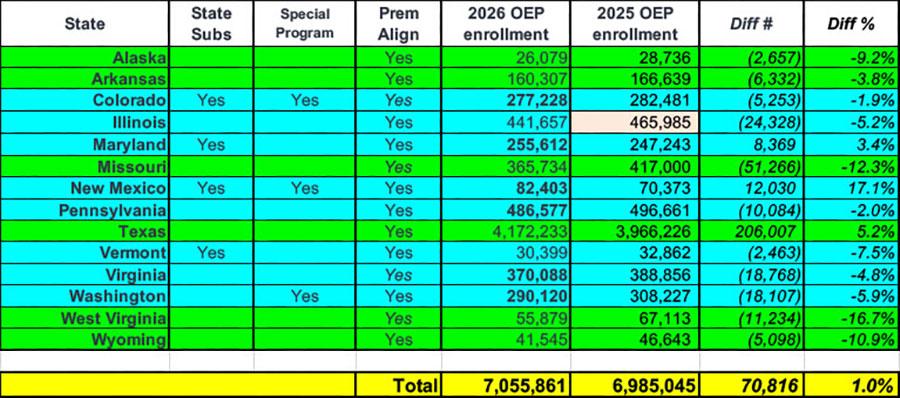
Across the 14 states which have Premium Alignment policies in place (some weak, some strong; I'm including any state where the average subsidized Gold plan premium for a 50-yr old earning $50,000/year costs less than the average Silver plan premium for the same enrollee), total enrollment is actually up 1.0% y/y.
Extrapolated out nationally, this would amount to 24.56 million enrollees...~243,000 more than last year, and around 1.5 million higher than the actual total.
Again: These are oversimplifications--and of course some states have one, two or all three of these factors in place (notice how New Mexico is listed in all three categories). The larger point is still pretty clear, however. Here's what it looks like when I combine all three of these categories together: A mere 0.3% plan selection drop.
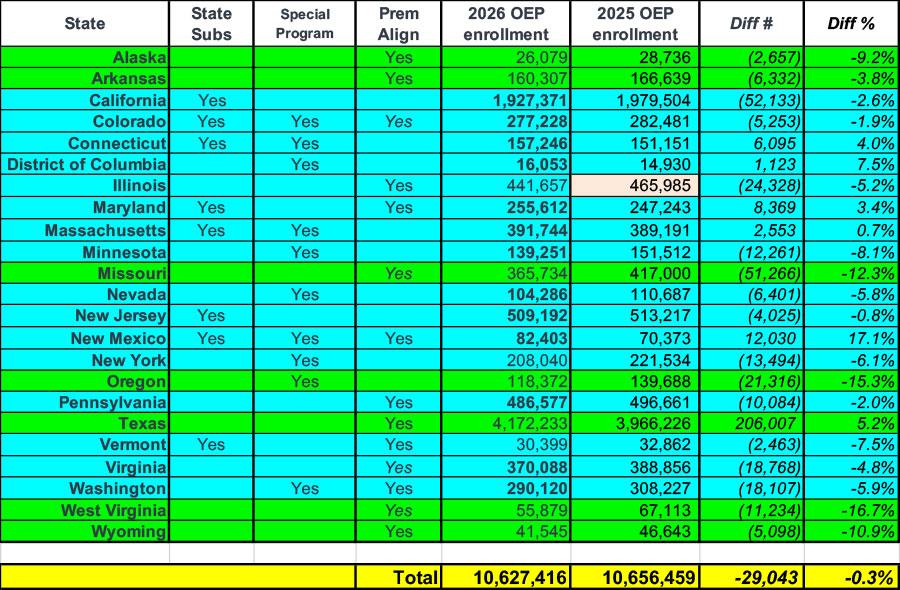
Oh yeah, one more thing: Here's what it looks like for the remaining 28 states which don't have any of these programs or policies in place:
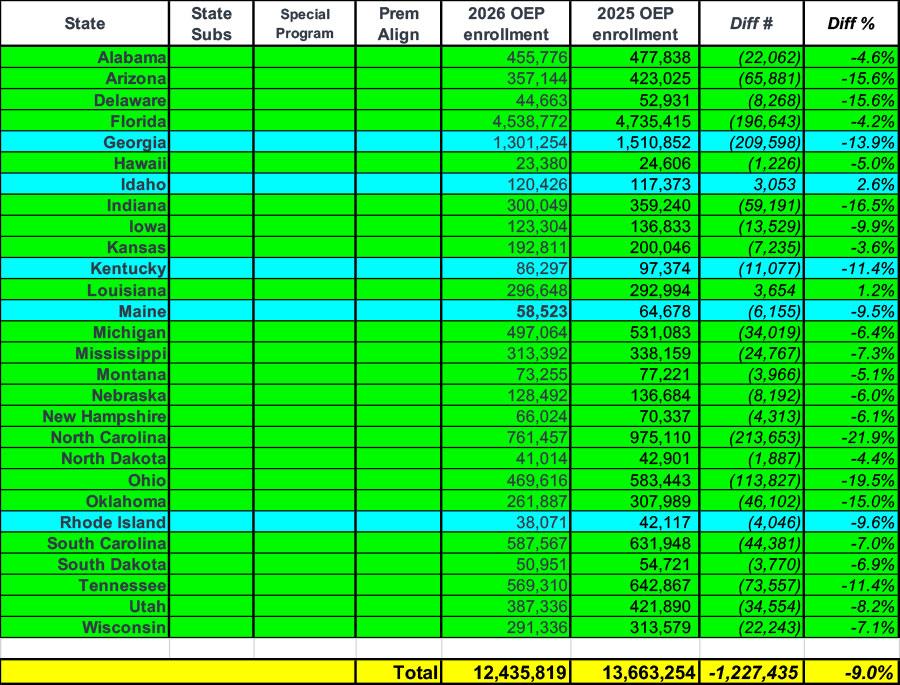
Across these 28 states, overall enrollment is down a whopping 9.0%.
Extrapolating that out nationally suggests that if none of the 50 states +DC had state subsidies, BHP programs, "Public Options" or Premium Alignment in place, total 2026 OEP plan selections would have been nearly 2.2 million lower than it was in 2025...a drop over 930,000 higher than it actually was.
All in all, as far as I can figure, the gap between having these policies in place in every state and not having them in place in any state is a gap of up to 2.4 million people or so.
Bottom line: No matter how you slice it, these policies are helping hundreds of thousands of Americans keep their healthcare coverage who otherwise would have lost it...and none of this even goes into the hundreds of thousands more who were able to enroll in better coverage thanks to these measures.
Advertisement


