


We're past December 15th. Now what? (Also: Extensions in IL & PA, and an important update in CT!)
Tue, 12/16/2025 - 9:05am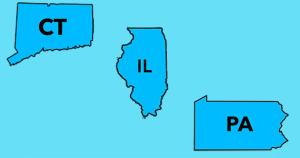
We're now over the hump: The initial deadline for people to enroll in ACA healthcare coverage starting on January 1st has passed in most states.
HOWEVER, there's some important caveats to this, as well as some last-minute deadline extensions in a couple of states, so let's dig in...
- If you live in IDAHO, last night was the one and only Open Enrollment Period deadline.
This means that if you didn't actively select a plan for 2026, current enrollees are stuck with whatever plan Your Health Idaho automatically renewed theme into, while uninsured residents who didn't sign up by the deadline are mostly out of luck.
The exceptions to this for both categories are a) if they're members of a federally-recognized Native American tribe (or are Alaska Natives); or b) if they are (or become) eligible for Medicaid or the Children's Health Insurance Program (CHIP). All of these are eligible to enroll year-round.
A third exception is if they become eligible for a 60-day Special Enrollment Period (SEP); this includes qualifying life changes like getting married/divorced; giving birth/adopting a child; moving outside of their current rating area; or losing existing coverage (ie, employer-based, no longer qualifying for Medicaid, etc).
- If you live in most other states and either missed the deadline entirely or don't like the plan that you were auto-renewed into, you still have until at least January 15th to enroll or to switch plans.
The catch in these cases is that if you do so, the new plan won't go into effect until February 1st. This means that if you didn't enroll/get renewed for January coverage, you won't have coverage for the month of January (so be very, very careful not to get sick or injured)...and if you did enroll/get renewed for January coverage, you'll be enrolled in that plan for January only, with it switching over to the new one starting February 1st.
Besides potentially being logistically messy (new insurance cards, having to update/change your policy number with your healthcare providers twice, changing your auto-payment settings twice, etc), this also means that your deductible & maximum out-of-pocket costs will likely reset twice as well.
In other words, switching insurance policies twice in less than a month is not something I would recommend in most instances, but it might be the best course of action for some enrollees...especially if Congress is able to pull off a last-minute (or even retroactive) subsidy extension deal after all.
- There are some states with deadlines later than December 15th to enroll in coverage starting January 1st, however. These include:
- MASSACHUSETTS: December 23rd for January 1st coverage
- CALIFORNIA: December 31st for January 1st coverage
- MARYLAND: December 31st for January 1st coverage
- NEVADA: December 31st for January 1st coverage
- NEW JERSEY: December 31st for January 1st coverage
- NEW MEXICO: December 31st for January 1st coverage
- RHODE ISLAND: December 31st for January 1st coverage
- VIRGINIA: December 31st for January 1st coverage
IN ADDITION, there are two more states which just announced DEADLINE EXTENSIONS this morning!
- ILLINOIS has extended their deadline to enroll for January 1st coverage out to December 31st as well
- PENNSYLVANIA has extended their deadline to enroll for January 1st coverage out to December 31st as well
ALSO, there are special health insurance programs in several states which offer year-round enrollment for eligible residents (these are mostly based on household income):
- Connecticut: Covered Connecticut
- District of Columbia: Healthy DC (Basic Health Plan)
- Massachusetts: ConnectorCare
- Minnesota: MinnesotaCare (Basic Health Plan)
- New York: Essential Plan (Basic Health Plan)
- Oregon: Bridge Program (Basic Health Plan)
FINALLY, this has nothing to do with any enrollment deadlines, but CONNECTICUT has made an important announcement regarding a new SUPPLEMENTAL STATE SUBSIDY PROGRAM:
Connecticut will spend $70 million to partly offset the looming loss of $295 million in enhanced federal tax credits that subsidize health insurance premiums for tens of thousands of residents under the Affordable Care Act, Gov. Ned Lamont said Thursday.
Using emergency authority granted him by the General Assembly in special session last month, the governor announced the commitment minutes after the U.S. Senate failed to advance either a Democratic proposal to extend the credits or a Republican alternative.
“This is a one-year fix,” Lamont told reporters in a hastily called press conference outside his office at the state Capitol. “We’ll be able to mitigate the pain coming out of the confusion in Washington.”
The state money is expected to keep premiums stable for singles earning up to $56,000 annually and for families of four earning up to $128,000, Lamont said.
Technically speaking, $56K for one person is 358% FPK while $128K for 4 people is 398% FPL; I'm guessing Lamont didn't mean those exact figures and basically just meant enrollees earning up to 400% FPL, but I could be wrong.
“We’re also working with OPM and Access Health to see if we can find a partial subsidy for folks earning a little bit more than that, say $75,000 for a single and $160,000 for a family of four,” Lamont said.
That would be 479% or 600% FPL FWIW.
The rest of the article makes it clear that the exact details of the state subsidies including how they'd be allocated, whether they'd be made retroactively and so on are still being worked out, but the bottom line is that this will be a godsend to thousands of Connecticut enrollees. $70 million would be around 24% of the lost federal tax credits, so it's not a panacea, but it's still a hell of a lot better than nothing, especially considering that Connecticut's average premiums will be the 5th highest nationally in 2026.
As always, read my 2026 Open Enrollment Guide for more important info.
Advertisement


